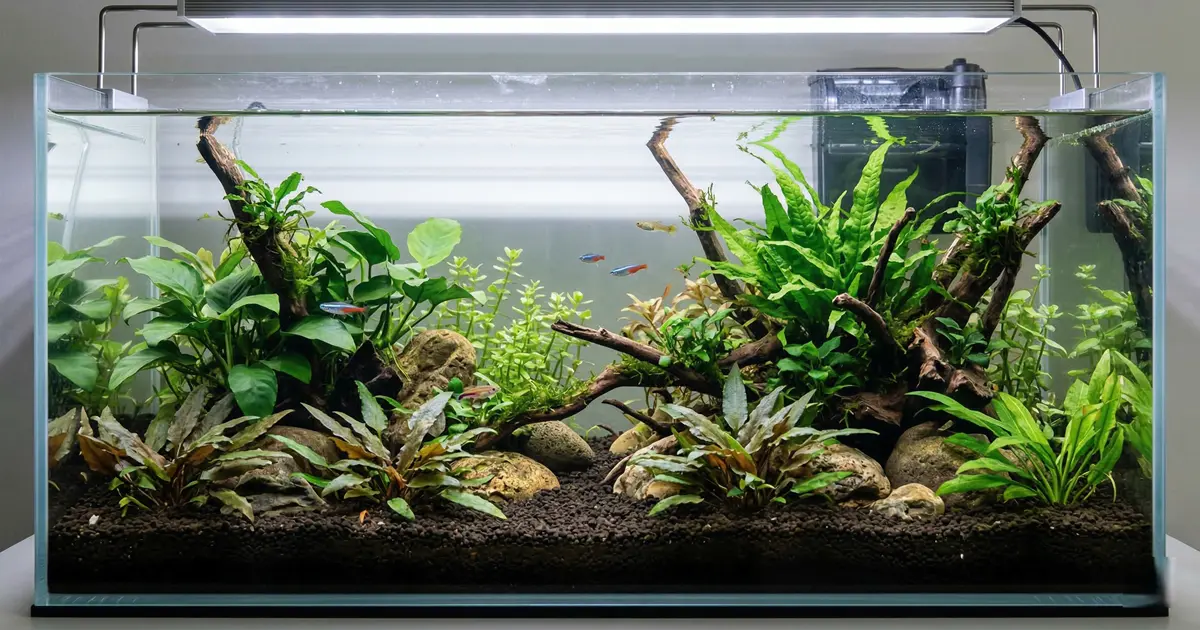
How to Set Up a Low-Tech Planted Aquarium
Dreaming of a lush, vibrant aquascape but intimidated by complex CO2 systems and daily fertilizer regimens? A low-tech planted aquarium is your perfect starting point. By balancing light, nutrients, and the right plant species, you can build a stunning underwater ecosystem that thrives with minimal maintenance.
What Defines a Low-Tech Tank?
In aquascaping, "low-tech" simply means running a planted tank without pressurized CO2 injection. These setups rely on ambient CO2, lower lighting intensities, and nutrient-rich substrates. Growth is slower, which means less pruning and a highly forgiving environment for beginners.
Step 1: Tank Selection and Placement
Your tank's dimensions dictate everything from gas exchange to light penetration. Standard rectangular tanks (like a 20-gallon long) are ideal for beginners because their shallow depth allows light to reach carpeting plants easily. Before filling it up, always use a Volume Calculator to know your exact water capacity, and if you're custom-building, double-check safety with a Glass Thickness Calculator.
Step 2: Building the Foundation (Substrate)
Since you aren't injecting CO2, your plants need a solid nutrient reserve at their roots. An active soil substrate is highly recommended. It buffers the pH and provides essential macro and micro nutrients right out of the bag.
Not sure how many bags to buy? Avoid the guesswork and use our Substrate Calculator to find the exact volume required for your desired slope and depth.
Step 3: Filtration and Water Flow
Good circulation is vital. It distributes nutrients, removes waste, and prevents dead spots where algae can bloom. For low-tech setups, aim for a filter that turns over your tank volume 4 to 6 times per hour. You can easily find the perfect match using our Filter Flow Rate Calculator.
Step 4: Nailing the Lighting
Lighting is the engine of your planted tank, but too much of it in a low-tech setup will result in an algae farm. Aim for low to medium light intensity and keep your photoperiod between 6 and 8 hours a day. Check your specific PAR requirements with our Lighting Calculator.
Step 5: Temperature Control
Stable temperatures keep your plants and fish stress-free. Most tropical aquatic plants thrive between 72°F and 78°F. An undersized heater will struggle and eventually fail, so make sure to run your tank specs through our Heater Calculator before purchasing your equipment.
Best Plants for a Low-Tech Aquascape
- Epiphytes: Anubias, Java Fern, and Bucephalandra (attach these to hardscape; do not bury the rhizome).
- Stem Plants: Water Wisteria, Bacopa Caroliniana, and Pearl Weed.
- Cryptocorynes: Crypt Wendtii and Crypt Lutea (great for midground bushy growth).
Frequently Asked Questions
Do I need fertilizers in a low-tech tank?
While an active substrate provides root nutrients, a comprehensive liquid fertilizer dosed once a week helps feed epiphytes and stem plants that absorb nutrients directly from the water column.
How often should I do water changes?
During the first month, aim for 30-50% weekly water changes to remove excess nutrients leaching from the soil. Once established, you can typically scale back to 20-30% every week or two depending on your bioload.
Can I grow a carpet without CO2?
It's challenging but possible. Plants like Pearl Weed, Dwarf Sagittaria, or Monte Carlo can form carpets in low-tech setups, though they will grow much slower and require a high-quality, nutrient-rich substrate.